Sales Enablement Meaning: A Practical Guide for Tunisian SMEs
Sales enablement meaning is the organised process of giving salespeople the knowledge, tools, information, and workflow they need to guide customers from an initial question to a completed purchase and a useful follow-up. For a Tunisian retailer, it is not simply “selling better”: it connects product knowledge, stock availability, pricing, quotations, checkout, customer records, and reporting so that staff can act accurately at the moment of sale.
Table of Contents
- What sales enablement means in daily business operations
- Why sales enablement matters for Tunisian SMEs
- How a sales enablement system works
- Where sales enablement breaks down
- How Tunisian businesses can apply the concept
The idea applies beyond a classic sales team. A supermarket cashier recommending a larger pack, a café worker handling a catering request, a wholesaler preparing a quotation, and a repair shop calling a customer when an item is ready are all performing sales work. Their enablement system may be a point-of-sale application, inventory records, product sheets, scripts, customer history, and clear rules for discounts and follow-up.
What sales enablement means in daily business operations
Sales enablement is best understood as an operating system for commercial conversations. It answers five practical questions:
- What should the employee know? Product specifications, variants, prices, warranties, use cases, and common objections.
- What should the employee do? Qualify the request, check availability, recommend an option, prepare a quotation, sell, deliver, or schedule follow-up.
- What information should be visible? Current stock, reserved quantities, customer history, supplier lead times, payment status, and previous quotations.
- Which action is authorised? Whether a cashier can apply a discount, change a price, cancel a receipt, or offer credit.
- How will the owner know what happened? Through sales records, margin reports, customer activity, and unresolved opportunities.
That makes sales enablement broader than sales training. Training might teach a cashier how to explain the difference between two coffee machines. Enablement also gives the cashier a dependable product record, a way to check stock in another location, a controlled price list, and a process for recording the customer’s decision.
Industry definitions commonly treat enablement as a combination of content, coaching, training, and technology that helps sellers engage buyers more effectively. Salesforce describes the discipline in those terms in its sales enablement overview. The useful implication for a small business is that software alone is not enablement. A screen full of data without a decision process simply moves confusion from paper into a computer.
Enablement is not the same as promotion
Promotion creates attention. Enablement improves the business’s ability to handle the attention. An advertisement may bring a customer to a shop or generate a message on social media. The employee still needs to answer whether the product is available, what it costs, which alternative fits the customer, and when delivery can occur.
It is also not the same as pressure-selling. Good enablement helps an employee make a relevant recommendation and give an accurate answer. That matters in Tunisia’s relationship-driven retail environments, where a confident but incorrect promise about availability can cost more than one lost transaction: it can damage trust with a family, a contractor, a restaurant buyer, or a local reseller.
A simple distinction for owners and consultants
Use this test: if a capable new employee joined tomorrow, could the business help that person handle a normal customer request without repeatedly asking the owner? If the answer is no, the gap may be an enablement problem involving knowledge, information, authority, or workflow.
For example, a wholesaler may have excellent salespeople but weak enablement if they cannot see stock by warehouse. A grocery shop may have accurate inventory but weak enablement if cashiers cannot identify substitutes when a fast-moving product is unavailable. A repair business may have skilled technicians but weak enablement if no one records the customer’s approval for parts and labour.
Why sales enablement matters for Tunisian SMEs
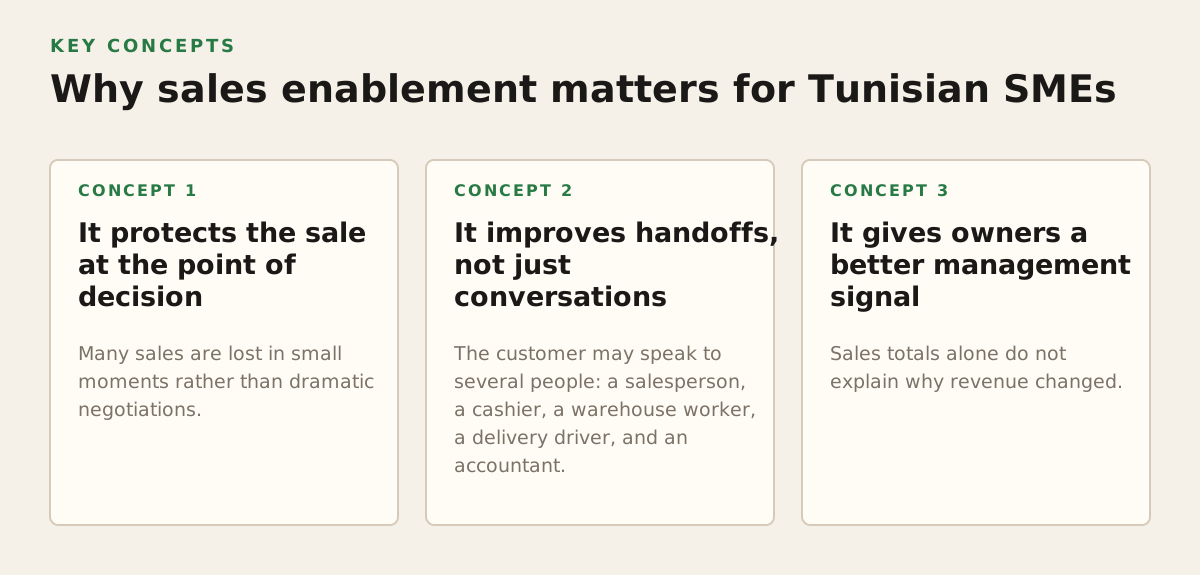
Small businesses often depend on a few experienced people. The owner knows which supplier is reliable, which customer usually pays late, which product has a higher margin, and which alternative can be offered when stock runs out. That knowledge is valuable but fragile when it exists only in memory or private messages.
Enablement reduces dependency on individual memory by turning repeatable knowledge into a visible process. It does not remove judgement. It makes the facts surrounding that judgement easier to retrieve and easier for another employee to follow.
It protects the sale at the point of decision
Many sales are lost in small moments rather than dramatic negotiations. A worker cannot confirm a price. A product is shown as available but is missing from the shelf. A quotation is delayed until the customer chooses another supplier. A promised callback is forgotten. A discount is applied inconsistently and leaves the owner unsure of the margin.
A connected workflow addresses those moments by putting the relevant next action near the transaction. The objective is not to make staff read a long manual. It is to make the correct action easier than the improvised one.
For a shop, useful enablement may produce these operational effects:
- A cashier searches an item by barcode or name and sees the approved selling price.
- A sales employee checks whether a different size or colour exists before promising it.
- A distributor prepares a quotation from the same item and customer records used for invoicing.
- A restaurant manager records a corporate order with delivery notes instead of leaving the details in a personal chat.
- A repair desk links the customer, device, diagnosis, parts, labour, payment, and collection status.
It improves handoffs, not just conversations
The customer may speak to several people: a salesperson, a cashier, a warehouse worker, a delivery driver, and an accountant. Enablement matters because each handoff can lose information. If the customer repeats the same story three times or receives three different prices, the problem is usually a broken process rather than a lack of enthusiasm.
A reliable handoff has an owner, a status, and a next action. “Call customer about quotation” is weaker than “Quotation Q-104 for 12 office chairs: waiting for delivery confirmation; Amel calls on Thursday.” The latter can be reviewed, delegated, and measured.
It gives owners a better management signal
Sales totals alone do not explain why revenue changed. A sales enablement view separates at least four situations:
- There were not enough customer enquiries.
- Enquiries arrived but staff could not answer or quote quickly.
- Quotations were issued but customers did not accept them.
- Orders were accepted but stock, delivery, invoicing, or payment execution failed.
These situations require different decisions. More advertising may help the first. Better product information may help the second. Pricing or offer design may affect the third. Inventory and fulfilment controls address the fourth. Without that separation, an SME can spend money attracting more demand while failing to serve the demand it already receives.
Digital measurement should also be defined carefully. Google’s official documentation distinguishes events from conversions in Analytics and explains how businesses can mark important events as conversions; see the Google Analytics conversion setup guidance. For a local shop, the equivalent principle is simple: define what counts as a completed sale, a qualified quotation, a paid invoice, or a collected repair before judging the process.
How a sales enablement system works
A practical system has four connected layers: knowledge, workflow, authority, and evidence. A weakness in any layer can interrupt the customer journey.
1. Knowledge: give staff usable answers
Knowledge should be organised around customer decisions, not around everything the owner knows. A product record might include:
- Customer-facing name and internal reference.
- Purchase unit and selling unit.
- Available variants, sizes, colours, or models.
- Compatible accessories or complementary items.
- Approved selling price and discount limits.
- Warranty, installation, delivery, or usage notes.
- Substitute products when the preferred item is unavailable.
Good sales content is short enough to use during a real conversation. A supermarket employee does not need a supplier’s entire catalogue to recommend a detergent. A technician preparing a repair quotation needs the part cost, labour option, expected timing, and approval status—not a general lecture about the brand.
Use different formats for different work. A two-line product note helps at checkout. A comparison table helps a salesperson. A troubleshooting checklist helps a service desk. A policy sheet helps managers decide which discounts or returns require approval.
2. Workflow: connect the customer request to the transaction
A workflow gives a request a predictable path. One useful general sequence is:
- Capture the customer, company, or walk-in reference.
- Record the request, products, quantities, and required date.
- Check price and availability from the current records.
- Recommend, quote, reserve, or sell according to the situation.
- Convert the accepted request into an invoice, receipt, delivery, or work order.
- Record payment, balance, delivery status, or collection status.
- Schedule the next action if the relationship continues.
The sequence should not be identical for every business. A fast-food counter needs speed and order accuracy. A distributor may need credit checks, warehouse selection, and delivery planning. A consultant may need a proposal and appointment calendar. The principle is the same: the next operational step should be visible before the customer has to ask for it.
3. Authority: define what staff may decide
Employees need enough authority to serve customers without creating uncontrolled risk. Write down rules such as:
- Which staff may change a price, and within what approved range.
- When a manager must approve a return or cancellation.
- Who may reserve scarce stock for a customer.
- Whether a quotation expires after a defined period.
- Which customers may buy on account and who approves the limit.
- When a promised delivery date must be confirmed by the warehouse.
These are not merely control rules. They are confidence tools. A salesperson who knows the limit can make an offer immediately. A salesperson who must ask the owner about every small decision either delays the customer or starts making private exceptions.
4. Evidence: record what happened
Enablement becomes measurable when the business records the steps that matter. The minimum useful record depends on the business, but often includes customer identity, products, quantity, price, status, employee, payment condition, and next action.
For digital campaigns, Google Ads explains conversion tracking as a way to understand actions that matter after an interaction with an advertisement; its official conversion tracking guide covers the concept. A Tunisian SME does not need to copy an online advertising setup to use the lesson: a sale, accepted quotation, or paid invoice should be distinguishable from a casual enquiry.
A worked example with illustrative numbers
The following is an illustrative example, not a universal benchmark. Imagine a distributor receiving 40 customer requests in one week. The manager creates this starting policy:
- 30 requests receive a response or quotation within one working day.
- 20 quotations contain a recorded stock check and delivery condition.
- 10 accepted quotations are converted into invoices or delivery orders.
- Every open quotation has one next-action date.
- Any discount above 5% requires manager approval.
These numbers do not prove that the distributor will increase revenue. They create a falsifiable operating rule. After four weeks, the manager can inspect which requests were delayed, which quotations lacked stock confirmation, and which accepted orders failed during fulfilment. If the policy creates unnecessary work without improving visibility, it should be changed.
That is the important mechanism: sales enablement turns vague improvement goals into observable behaviours. “Be more responsive” is difficult to manage. “Every open quotation has an owner and next-action date” can be checked.
Where sales enablement breaks down
Enablement projects usually fail through ordinary operational friction, not because employees reject the idea of selling. The most common problems are incomplete data, excessive complexity, unclear ownership, and incentives that reward the wrong behaviour.
Bad stock data creates false confidence
A salesperson cannot enable a sale with an inventory quantity that is wrong. If the system says 18 units are available but five are damaged, two are reserved, and four are in another warehouse, the apparent availability is misleading.
Separate at least these states where the business needs them:
- Physical stock: what appears to be present.
- Available stock: what can actually be sold now.
- Reserved stock: committed to an order or customer.
- Damaged or quarantined stock: present but not sellable.
- Incoming stock: expected but not yet received.
A small shop may not need every state on every screen. A wholesaler with several storage locations probably needs more detail. The trade-off is clarity versus administrative effort. Start with the distinctions that prevent the most expensive promises.
Too much content slows the seller
Long manuals are often written to satisfy the manager rather than help the employee. If a cashier must open five screens to answer a common question, the real process becomes asking a colleague or guessing.
Keep a small set of high-frequency answers close to the product or transaction:
- What is it?
- Who is it for?
- What does it replace or complement?
- What is the approved price?
- Is it available, and where?
- What must happen after the sale?
Review these answers when suppliers change packaging, prices, warranty conditions, or delivery arrangements. Outdated enablement is worse than no enablement because it makes incorrect information look official.
Discounts can hide a process problem
When staff cannot explain value, they may compensate with discounts. When owners cannot see margin by product or customer, they may approve discounts inconsistently. This does not mean discounts are always wrong. It means the business should record the reason and authority behind them.
Measure discount behaviour alongside sales value. A transaction that increases turnover but consumes the margin needed for delivery, service, or bad-debt risk may not be a successful sale. For a restaurant, the equivalent issue may be an order that is accepted at a price but requires costly customisation. For a repair business, it may be a job where parts and labour are not both included in the quote.
Technology is introduced before responsibilities
A new application cannot decide who confirms a delivery, who approves a return, or who contacts an unpaid customer. If roles are undefined, the software will contain incomplete statuses and duplicated notes.
Before implementation, assign responsibility for each stage:
- Who creates the customer or company record?
- Who verifies the item and price?
- Who confirms stock or delivery timing?
- Who converts the accepted request into a sale?
- Who checks unpaid balances?
- Who reviews open quotations every week?
Then remove fields that no one will maintain. A smaller accurate record is more useful than a detailed record filled with guesses.
Vanity metrics replace commercial evidence
More conversations, messages, or quotations do not automatically mean better selling. The business should connect activity to a meaningful outcome. Useful measures can include:
- Response time for a new request.
- Percentage of quotations with confirmed availability.
- Accepted quotations converted into invoices.
- Orders delayed because of stock discrepancies.
- Average discount by employee or product group.
- Unpaid balances past their agreed due date.
- Repeat purchases by identifiable customers.
Choose only the measures that lead to a decision. If nobody will change staffing, purchasing, pricing, or follow-up after seeing a metric, it may not deserve collection.
How Tunisian businesses can apply the concept
Apply sales enablement to one customer journey first. Do not begin with a large library of documents or an ambitious transformation programme. Select a journey where lost information has a visible cost, then connect its commercial and operational steps.
Retail, grocery, and supermarket operations
Start with the questions staff hear most often: price, availability, substitute, pack size, promotion condition, and return rule. Link the item catalogue to checkout so that the price used in the sale is controlled rather than copied from an old paper list.
For fast-moving groceries, the best enablement may be less about persuasive scripts and more about availability discipline. A worker should know whether a missing shelf item is genuinely out of stock, waiting for replenishment, or stored in another location. A manager can then decide whether to reorder, substitute, or adjust the shelf plan.
A practical starting routine is:
- Review the 20 products most frequently requested but unavailable.
- Record one approved substitute for each where a substitute makes sense.
- Give staff a short explanation of the difference in price, size, or use.
- Check whether the substitute is actually available before recommending it.
- Review the list weekly and remove options customers reject.
The “20 products” figure is an illustrative starting policy, not a benchmark. A small neighbourhood shop may begin with five; a supermarket may need separate lists by department.
Cafés, restaurants, and fast-food businesses
Here the transaction is time-sensitive. Enablement should protect order accuracy, availability, modifiers, and payment status. Product knowledge can include allergens or preparation constraints only where the business has verified the information and trained staff to communicate it responsibly.
For catering or office orders, separate the enquiry from the final order. Record headcount, menu, delivery location, required time, deposit, balance, and changes. A verbal promise in a busy service period is not a reliable production ticket.
Use the POS as an execution tool, not as a substitute for menu discipline. If an item is unavailable, update the operational status promptly. If custom requests require approval, make that status visible. Speed at the counter is valuable, but speed that produces refunds, remakes, or missed deliveries is false efficiency.
Wholesalers and distributors
Wholesalers need enablement across products, customers, warehouses, credit, and delivery. A salesperson may need to answer a question that combines all five: “Can you supply 60 cases next Tuesday at the agreed customer price, and can we deliver to the second site?”
That answer cannot rely on a single generic stock number. The process should identify the relevant warehouse, reserved quantities, incoming goods, customer price conditions, and delivery commitment.
Use a quotation record when the sale is not immediate. Include:
- Customer and delivery location.
- Item references and quantities.
- Price, discount, tax treatment, and validity period.
- Stock source or replenishment assumption.
- Delivery condition and responsible employee.
- Approval status and next follow-up date.
For consultants recommending software to wholesalers, this is a useful evaluation question: can the proposed workflow preserve the difference between quoted, reserved, dispatched, and invoiced quantities? If not, the system may create sales confidence while leaving warehouse risk unresolved.
Repair, installation, and consulting services
Service businesses sell an outcome, not only an item. Enablement therefore needs a case or job record. It should connect the customer’s request to diagnosis, scope, estimate, approval, work status, parts or expenses, invoice, and follow-up.
A repair shop should avoid telling a customer “it will be ready tomorrow” before parts availability and technician capacity are checked. An installer should distinguish an initial estimate from an approved job. A consultant should distinguish an enquiry from a signed engagement and a delivered milestone.
A concise service workflow may be:
- Open a job with customer contact details and the reported problem.
- Record diagnosis or consultation scope.
- Prepare an estimate with labour, parts, and assumptions.
- Obtain approval before non-reversible work or purchases.
- Update status when work starts, pauses, or is ready for collection.
- Invoice and record payment or remaining balance.
- Schedule a warranty, maintenance, or follow-up contact where appropriate.
This creates a better customer conversation because the employee can explain what is known, what is pending, and what decision is required. It also gives the owner evidence when a job takes longer or costs more than expected.
Choosing the software layer
For a small Tunisian business, begin with the workflows that must agree with one another: inventory, invoicing, point of sale, cash, customers, suppliers, and reports. Separate tools can work, but every handoff creates another opportunity for duplicated entry or conflicting information.
When evaluating an application, ask for a demonstration using your own scenario rather than a generic catalogue. Test a normal sale, a partial payment, a return, a stock transfer, a quotation becoming an invoice, and an unpaid customer balance. For a multi-location business, test stock by location. For a service business, test a job from intake to payment.
Also check practical adoption constraints:
- Can staff use the interface in the languages needed by the business?
- Does it run on the computers and operating systems already used?
- Can the owner export or review the records needed by the accountant?
- Are permissions understandable to non-technical managers?
- Can the business continue its daily work without creating duplicate paper and digital records?
- Is the payment model clear, including what is included and what remains the owner’s responsibility?
For a Tunisian SME, a sensible starting policy is to document one complete journey, train the people involved, and review the exceptions after the first operating cycle. The duration of that cycle should match the business: a busy grocery store may review issues quickly, while a distributor with longer quotations may need a longer observation period. This is a planning choice, not a universal implementation timetable.
Sales enablement works when it makes accurate action easier: the right product, at the right price, from the right stock location, for the right customer, with the next obligation recorded. Inventisia’s Windows and macOS business management application brings inventory, electronic invoicing, point of sale, cash management, customers, suppliers, and reporting into one desktop workflow, with French, Arabic, and English support and lifetime access for a one-time payment. Inventisia
Authored with NotFair SEO
Download Inventisia Now
600 DT · Lifetime access · 3-day free trial · WhatsApp support
Download the app