Retail Sales: How Tunisian SMEs Turn Every Transaction Into Better Stock Decisions
Retail sales are the exchange of goods or services for money at the point where a business serves its customer. For a Tunisian grocery, that may mean scanning a bottle of water and accepting cash; for a café, it may mean closing a table ticket; for a repair shop, it may mean invoicing labor and a replacement part. The important management idea is that a sale is not only revenue: it is also a stock movement, a payment event, a customer record, and evidence for later reporting.
Table of Contents
- What Retail Sales include in a small business
- Why Retail Sales data matters beyond the daily total
- How a Retail Sales workflow should work
- Where Retail Sales systems break
- How practitioners use Retail Sales information
- Using data to expand sales without losing control
- A practical operating policy for 2026
What Retail Sales include in a small business
A retail sale has four connected layers. The first is the commercial layer: what the customer bought, at what price, and under which discount or tax treatment. The second is the operational layer: which item leaves stock, from which location, and in what quantity. The third is the financial layer: whether the customer paid in cash, by card, on account, or through a split payment. The fourth is the control layer: whether the transaction can be traced, corrected, refunded, and included in a useful report.
This distinction matters because a cash register can show a total while still leaving the manager unable to answer basic questions. Which products are selling in each branch? Which cashier entered the discount? Did the warehouse transfer reach the shop? Are unpaid customer balances growing? A sale is useful data only when these relationships remain attached to the transaction.
Retail sales versus wholesale and service transactions
Retail normally involves many relatively small transactions, quick product selection, and immediate payment. A wholesaler may issue fewer invoices but handle cartons, negotiated prices, customer credit, delivery notes, and several warehouses. A service business may have little conventional stock but still needs to record an installation, consultation, repair fee, spare part, or advance payment.
The same management system can support these cases if it separates the underlying objects:
- Items and services: products, repair labor, consultations, menu items, or installation charges.
- Documents: quotations, sales tickets, invoices, credit notes, receipts, and delivery records.
- Parties: walk-in customers, named customers, suppliers, companies, and staff users.
- Locations: a shop floor, back room, warehouse, vehicle, or second branch.
- Payments: cash, bank transfer, card, customer credit, advance, or a split settlement.
For example, a wholesaler selling 12 cases of soft drinks should reduce the correct warehouse quantity, apply the agreed customer price, record the invoice balance, and preserve the delivery reference. A supermarket selling one bottle should perform the same logical sequence at much greater speed. Speed changes the interface; it does not remove the need for traceability.
The minimum information behind a sale
At minimum, a manager should be able to retrieve the date, document number, seller or cashier, item or service, quantity, unit price, discount, tax configuration, payment method, customer when relevant, and stock location. The exact fields depend on the business and its accounting process, but removing too much information creates expensive questions later.
Product identification is especially important when names are inconsistent. A barcode can provide a repeatable identifier, but it does not automatically guarantee correct pricing or stock data. GS1 explains the role of barcodes and identification standards in connecting products to information across supply chains in its official standards overview: GS1 barcode standards. For a Tunisian retailer, the practical lesson is to maintain one clean product record rather than rely on a cashier remembering variations of the same name.
Why Retail Sales data matters beyond the daily total
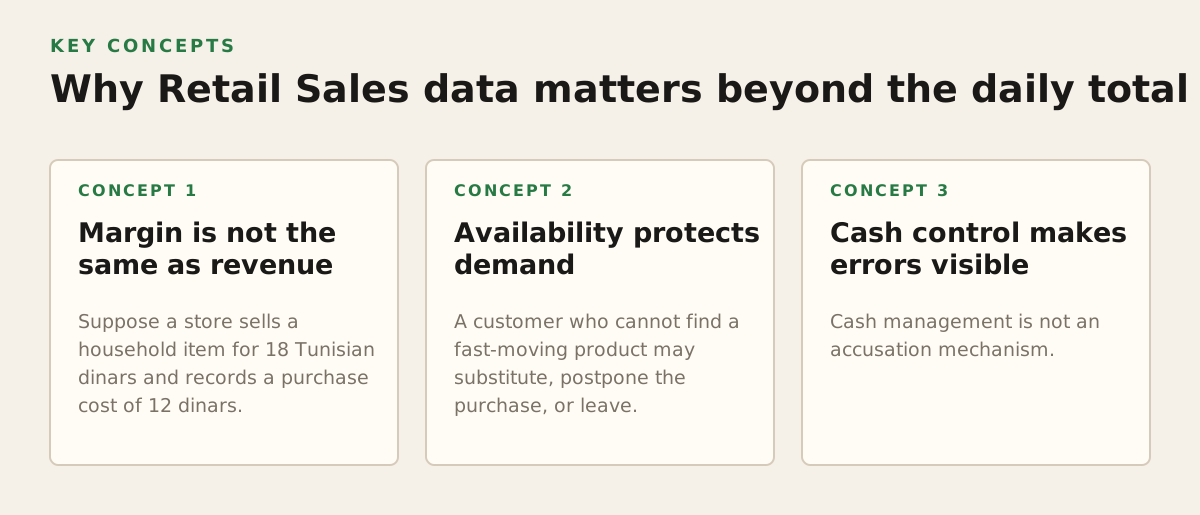
The daily revenue figure answers only one question: how much was sold under the selected filter. Management decisions require more precise measures. A shop needs to know whether revenue came from profitable products, whether cash agrees with recorded payments, whether sales are concentrated in a few items, and whether stock is available when customers ask for it.
Margin is not the same as revenue
Suppose a store sells a household item for 18 Tunisian dinars and records a purchase cost of 12 dinars. The gross margin before other expenses is 6 dinars. If a discount reduces the selling price to 15 dinars, the transaction may still be positive, but the margin has changed. If the cost record is missing or stale, the sales report can look healthy while the margin calculation is fiction.
Use margin reports as a decision aid, not as an unquestioned truth. They depend on the quality of purchase costs, units of measure, returns, discounts, and stock adjustments. Revenue tells you what customers paid; margin helps explain what the sale contributed before operating expenses.
Availability protects demand
A customer who cannot find a fast-moving product may substitute, postpone the purchase, or leave. A retailer therefore needs two different views:
- Sales velocity: how many units or service tickets were sold during a chosen period.
- Availability: how many sellable units are currently recorded at the relevant location.
These views must not be confused. A product can have high past sales and zero current stock. It can also have a large stock balance but weak demand, tying up cash and shelf space. An illustrative starting policy might be to review the 20 most frequently sold products weekly and investigate any item with three consecutive days of zero availability. That is a management example, not a universal benchmark; a pharmacy, café, clothing shop, and wholesaler will need different rules.
Cash control makes errors visible
Cash management is not an accusation mechanism. It is a reconciliation mechanism. At closing, the operator should compare the expected amount with the counted amount, while separating cash sales, card receipts, transfers, refunds, and payments received against older credit invoices.
Useful reports can expose:
- cashier sessions with unusual voids or refunds;
- discounts outside the owner’s normal policy;
- unpaid invoices by customer and age;
- differences between opening cash, recorded movements, and closing cash;
- sales made from the wrong location or under the wrong price list.
Reconciliation is strongest when it happens every day, while the people, tickets, and payment evidence are still available. Waiting until the end of the month turns a small discrepancy into an investigation with too many possible causes.
How a Retail Sales workflow should work
A reliable workflow is a chain of controlled events rather than a single “save” button. The sequence below suits a small shop or café, with adjustments for wholesale and services.
1. Prepare the master data
Before the first transaction, define product names, categories, units, purchase costs, selling prices, tax settings, suppliers, reorder information, and opening quantities. For a café, create menu products and optional ingredients according to the level of stock control the owner can realistically maintain. For a repair business, separate billable labor from parts and record the device or job reference in the customer file.
Do not create a new product every time a cashier sees a spelling difference. A practical naming policy can include:
- one short customer-facing name;
- one internal reference or barcode;
- one base unit, such as piece, kilogram, liter, box, or hour;
- one defined conversion when purchasing and selling units differ;
- one category and supplier relationship.
Unit conversion deserves special care. If a wholesaler buys 10 boxes of 24 pieces and sells individual pieces, the system must know whether the stock is tracked in boxes, pieces, or both. An incorrect conversion can create a stock balance that appears precise but is operationally wrong.
2. Capture the transaction at the point of sale
The operator selects items by barcode, search, category button, or customer order. The system calculates quantities, prices, discounts, and totals from stored rules. The operator then confirms the customer and payment details required for that transaction.
A grocery checkout benefits from large, fast product lookup and minimal typing. A restaurant needs table, order, course, and cancellation handling. A wholesaler needs customer-specific prices, quantities, delivery details, and credit terms. A service business needs an easy way to add labor, parts, notes, and a promised completion date. The right point-of-sale screen follows the job, not an abstract idea of a “standard” sale.
3. Post stock and payment movements together
Once the sale is confirmed, the operational consequence should be clear: the sold quantity leaves the selected location, and the payment or receivable is recorded in the appropriate account or cash movement. If a transaction is interrupted halfway, staff should know whether it is a saved draft, a completed sale, or a cancelled document.
This is why separate spreadsheets for sales and stock are fragile. Someone must copy the sale into the stock file, update the cash sheet, and perhaps enter the customer balance elsewhere. Each copy creates an opportunity for a different date, quantity, or price. Integrated posting reduces re-entry; it does not eliminate the need for review.
4. Handle returns and corrections as controlled events
A return should identify the original sale where possible. The business must decide whether the product is returned to sellable stock, quarantined for inspection, exchanged, or written off. A price correction should preserve the original document and create an adjustment rather than silently overwriting history.
Illustrative transaction chain:
- A customer buys 3 units at 25 dinars each: gross line value is 75 dinars.
- A 5-dinar discount is applied: the payable total becomes 70 dinars.
- The system decreases stock by 3 units and records the selected payment of 70 dinars.
- One unit is returned in saleable condition: stock increases by 1 and the refund or credit is linked to the return.
- The final retained sale is 2 units, with the corresponding net amount and audit trail.
The numbers above are an illustrative example, not a tax or accounting rule. The point is the relationship between the original sale, the physical item, the payment, and the correction.
5. Close and review the session
At the end of a shift, staff should count the payment instruments they are responsible for and compare them with recorded movements. Managers can then inspect exceptions instead of manually rereading every ticket. A short closing checklist can include:
- count cash by denomination;
- confirm card or transfer totals from available evidence;
- review refunds, voids, and unusual discounts;
- check pending orders and unpaid balances;
- record a cash difference with an explanation rather than hiding it.
Where Retail Sales systems break
Software cannot correct a process that the business has not defined. Most failures occur at the boundaries between people, products, locations, and documents.
Bad product data creates false precision
Duplicate product records split the sales history. Missing purchase costs distort margin. A product sold by piece but purchased by carton causes quantity errors. A price copied from an old promotion remains active after the promotion ends. These errors often look like software problems because the report is cleanly formatted.
Assign responsibility for master data. In a small business, one owner or manager can approve new products, price changes, and unit conversions. Cashiers should be able to sell, but not necessarily alter every sensitive field. Restricting high-impact edits is more useful than giving everyone unrestricted convenience.
Offline habits and late entry weaken the record
Staff sometimes write sales on paper during a busy period and enter them later. This may be necessary during a temporary outage, but it introduces missing items, wrong dates, forgotten discounts, and duplicate entry. If a fallback process is unavoidable, number the paper tickets, assign one person to reconcile them, and mark each one as entered.
For a business operating on Windows or macOS, the practical requirement is not a theoretical promise of perfect connectivity. It is a clear operating procedure for interruptions, backups, device changes, and end-of-day verification. Ask the software provider how data is backed up, restored, exported, and protected by user permissions before committing to a workflow.
Multiple locations hide the real stock position
A retailer may see 40 units in total and assume the item is available, while all 40 are in a warehouse two hours from the shop. A transfer that is physically in transit should not be counted as sellable shelf stock. The system should distinguish at least the source location, destination location, transfer status, and receipt confirmation.
Illustrative multi-location example:
- Shop A records 6 units available.
- Warehouse B records 30 units available.
- 8 units are dispatched from B but not yet received by A.
- The business should report 36 units physically available across locations, while Shop A still has only 6 sellable units.
This separation prevents a common purchasing mistake: ordering more stock because the manager looked at a global total without checking location availability.
Promotions and discounts can destroy margin quietly
A promotion should specify the eligible product, dates, customer or quantity condition, new price or discount amount, and approval authority. Otherwise, staff may apply a discount inconsistently or combine discounts unintentionally. The owner should review discount value as a share of sales, but treat any threshold as an internal starting policy rather than an industry law.
For example, a manager might require approval for discounts above 10 percent as an illustrative control. A high-end furniture seller may choose a lower or higher threshold; a supermarket may use preconfigured promotions instead. The correct policy is the one that reflects buying margins and staff responsibility.
Returns reveal process quality
Returns are not merely negative sales. They can signal wrong product information, damaged goods, sizing problems, order errors, or customer dissatisfaction. Categorize the reason and condition. If a particular item is returned repeatedly, investigate the supplier, description, packaging, or staff selection process.
Never use a generic stock adjustment to hide a return. That removes the connection between the customer document and the inventory event, making the next investigation harder.
How practitioners use Retail Sales information
Once transactions are reliable, the business can turn them into operating decisions. The goal is not to produce every possible chart. It is to answer recurring questions at the moment they matter.
For grocery stores and supermarkets
Start with availability and replenishment. Review fast-moving products by location, compare current quantity with supplier lead time, and identify items frequently sold out. Separate products with short shelf life from durable goods. A reorder rule should consider expected demand, delivery timing, minimum order quantities, storage capacity, and cash available.
A useful weekly meeting can examine:
- items with repeated stockouts;
- slow stock occupying valuable space;
- margin by category rather than only total revenue;
- supplier price changes affecting selling prices;
- shrinkage or adjustment patterns by location.
Do not automate replenishment until units, costs, and location balances are trustworthy. Automation applied to bad data simply orders the wrong goods faster.
For cafés, restaurants, and fast-food businesses
Restaurants often need speed, modifiers, order status, table or counter context, and clear cancellation controls. Decide whether ingredients will be deducted through recipes or whether the business will track only finished menu items. Recipe-level deduction can be valuable, but it creates maintenance work when portions, suppliers, or preparation methods change.
A sensible starting approach is to track high-value or frequently wasted ingredients first, then expand only when staff can maintain recipes. Record wastage separately from sales. Otherwise, the owner may blame the point-of-sale operator for a stock difference caused by preparation waste or spoilage.
For wholesalers and distributors
Wholesalers should prioritize customer price lists, units, credit limits or payment terms, delivery status, and warehouse transfers. A salesperson may prepare a quotation, but the warehouse needs a confirmed picking document and the customer needs an invoice or delivery record appropriate to the transaction.
Use customer history carefully. A large historical volume does not automatically mean a customer is profitable if discounts, delivery costs, delayed payment, and returns consume the margin. Reports should allow filtering by customer, product, salesperson, warehouse, and date range so the manager can see the commercial and operational sides together.
For repair, installation, and consulting businesses
Service businesses should not force every job into a product-only model. Create service items for labor or consultation, parts for physical stock, and a job or customer reference for the work context. The record should show what was promised, what was completed, what was billed, and what remains unpaid.
A repair shop can use statuses such as received, diagnosed, awaiting approval, in progress, ready, delivered, and closed. A consulting practice may instead need appointment dates, milestones, expenses, and installments. In both cases, the sale is the financial endpoint of a service process, not the whole process.
For accountants and business consultants
When recommending software to a Tunisian SME, inspect the workflow before inspecting the feature list. Ask to see how the business currently handles a sale, a return, a stock transfer, a customer credit payment, and a day-end cash count. Those five scenarios expose more practical risk than a long list of menu options.
A selection checklist should include:
- Can the team use the interface in its working language and document style?
- Can the business separate products, services, customers, suppliers, and locations?
- Can permissions distinguish cashier, manager, warehouse, and administrator tasks?
- Can the owner correct mistakes without deleting the original history?
- Can reports be filtered by date, user, location, customer, supplier, and payment method?
- Can data be backed up and recovered through a documented procedure?
- Can the business operate its core process on the available Windows or macOS computers?
For online expansion, a retailer should also plan how product names, prices, stock quantities, images, delivery conditions, and customer enquiries will stay consistent across channels. Choosing a suitable partner for e-commerce development can help the business launch an online store and expand retail sales channels without treating the website as a separate universe from the shop’s stock and order process.

Using data to expand sales without losing control
More traffic is not automatically better retail performance. A campaign can bring shoppers to an online catalogue or physical location while creating unprofitable discounts, unavailable products, or enquiries staff cannot answer. The operating system must connect marketing activity to product availability, order capture, payment, and fulfilment.
Measure the complete path
For a digital campaign, define the event that matters: a completed order, a qualified enquiry, a store visit with a recorded sale, or another measurable business outcome. Google’s official documentation explains that conversion tracking is used to understand actions people take after interacting with an ad, including actions valuable to a business: Google Ads conversion tracking guidance. In 2026, a Tunisian SME should still treat tracking as a measurement design problem, not simply paste a tag and assume every sale is attributed correctly.
Keep the following questions separate:
- How many people saw or clicked the promotion?
- How many reached a product or order page?
- How many completed a sale?
- What was the value after discounts, refunds, and cancelled orders?
- Could the business fulfil the demand from available stock?
Google also documents product data requirements for merchants, including information used to represent products in its shopping surfaces. Its official product data specification is available at Google Merchant Center product data guidance. The practical implication is that online expansion needs structured product information—titles, identifiers, prices, availability, and other attributes—not just attractive photos.
Paid campaigns need operational limits
A campaign manager should know which products are in stock, which locations can fulfil orders, and which margins can support advertising. A retailer can exclude a product from promotion when its stock is too low, pause an offer when a supplier delay occurs, or send shoppers to an alternative item. These are simple controls, but they require sales, stock, and marketing information to be connected.
If the business needs help managing paid search and marketing automation, AI-powered Google Ads management can help it manage Google Ads campaigns to attract more shoppers and increase retail sales while keeping campaign decisions connected to analytics and commercial goals.
Do not judge advertising by clicks alone. An illustrative starting report might compare campaign cost with completed sales, net sales after returns, gross margin, and fulfilment cost. The numbers and acceptable ratios must be set by the business’s own economics; no generic target is safe for every category.
Use reports for decisions, not decoration
A manager’s dashboard should have a small number of questions behind it:
- What sold today, by location and payment method?
- Which products need replenishment or a price review?
- Which customers owe money, and for how long?
- Where did stock change without a sale or purchase?
- Which discounts, returns, or cancellations need approval?
- Which products can be promoted without creating a fulfilment problem?
A report becomes trustworthy through definitions. “Sales” should make clear whether it includes tax, refunds, cancelled tickets, deposits, or unpaid invoices. “Stock” should distinguish available, reserved, damaged, and in-transit quantities where the workflow requires it. Without definitions, two staff members can export the same date range and reach different conclusions.
A practical operating policy for 2026
For a small Tunisian retailer, the best improvement is usually not buying every available module. It is establishing a disciplined sequence and choosing software that supports it without forcing duplicate work. Begin with the core catalogue, customers and suppliers, point of sale, invoicing, payment movements, stock locations, and reports. Add complexity only when the team can maintain the underlying data.
An illustrative rollout policy could look like this:
- First policy: every completed sale receives one identifiable document, even when the customer is a walk-in.
- Second policy: every stock correction includes a reason and an authorized user.
- Third policy: every shift closes with payment reconciliation.
- Fourth policy: every new product receives one approved name, unit, price, and stock location.
- Fifth policy: every promotion has an owner, a start condition, an end condition, and a margin review.
- Sixth policy: every backup and restore procedure is documented and periodically checked by the responsible manager.
These are starting policies, not universal legal or accounting requirements. The business should adapt them to its accountant’s advice, internal controls, transaction volume, and applicable Tunisian obligations. A consultant can also map the documents required by each activity before configuring the software.
Inventisia is designed for Tunisian SMEs that want one desktop application for inventory, electronic invoicing, point of sale, cash management, customers, suppliers, and reporting. It runs on Windows and macOS, supports French, Arabic, and English, and is offered with lifetime access for a one-time payment. For a retailer, café, wholesaler, distributor, repair shop, or consultant-led SME, the recommendation is specific: map your five most important workflows first, then use Inventisia to keep each sale connected to stock, payment, customer records, and management reports. Inventisia
Authored with NotFair SEO
Download Inventisia Now
600 DT · Lifetime access · 3-day free trial · WhatsApp support
Download the app