Aristid Retail Technology: What Retailers Should Know Before Adopting It
aristid retail technology refers to the retail-data and customer-engagement solutions associated with Aristid, a company serving retailers and consumer brands. It is not simply a cash register, stock ledger, or electronic invoicing application. The useful question for a Tunisian retailer is more specific: which commercial problem is Aristid intended to solve, what operational data must feed it, and what system should remain responsible for sales, stock, cash, and invoices?
Table of Contents
- What Aristid Retail Technology is—and what it is not
- Why the distinction matters for Tunisian retailers
- How the data and activation mechanism works
- Where an Aristid-style retail platform can break
- How practitioners should evaluate the fit
- A practical architecture for a Tunisian SME
That distinction matters because a supermarket, cosmetics chain, distributor, café, or repair business can easily buy a sophisticated customer-engagement layer while still lacking dependable item masters, stock movements, cashier controls, or tax-ready documents. A technology platform may improve campaigns and loyalty decisions, but it cannot repair inaccurate product quantities at the source. This explainer separates the concept from the surrounding retail stack and gives Tunisian SMEs a practical way to evaluate whether such a platform belongs in their architecture.
What Aristid Retail Technology is—and what it is not
Aristid presents itself as a retail technology company focused on helping retailers use data for customer relationships, loyalty, promotions, and retail media. Its public website describes activity around retail data and customer engagement rather than positioning the company as a general-purpose accounting or checkout application. See the company’s own overview for its current positioning: Aristid.
In practical terms, this category sits above the transaction layer. A point-of-sale system records that a customer bought three items. An inventory system adjusts available quantities and records the warehouse or shop involved. An electronic invoicing or accounting workflow produces the commercial and financial documents required by the business. A retail-engagement platform then uses selected information—subject to permission, quality, and business rules—to decide which customer, offer, message, or advertising opportunity is relevant.
It is a decision and activation layer, not automatically the operational system of record. A retailer should therefore map each fact to the application that owns it:
| Business fact | Likely system of record | What an engagement layer may do with it |
|---|---|---|
| Current quantity in a warehouse | Inventory or enterprise resource planning system | Suppress a campaign for an unavailable product |
| Items sold and payment method | Point of sale | Build an eligible purchase segment or measure a promotion |
| Customer consent and contact preference | Customer relationship or consent service | Decide whether a message may be sent |
| Campaign offer and validity dates | Promotion or campaign management workflow | Personalize, distribute, and report on the offer |
| Invoice number and tax document | Invoicing or accounting system | Use aggregated commercial data for analysis, not replace the document |
This division prevents a common procurement mistake: treating a retail media, loyalty, or data platform as a replacement for a reliable checkout and stock application. For a Tunisian grocery store with two tills, the first priority may be fast checkout, barcode discipline, purchase orders, stock transfers, cash closing, and electronic invoices. For a national retailer with several stores and a large permissioned customer base, audience activation and measurement may justify a separate platform.
The four ideas that are often confused
- Retail technology is the broad category: point of sale, inventory, commerce, payments, customer data, analytics, and store operations.
- Retail data is the structured information produced by transactions, products, customers, stores, campaigns, and suppliers.
- Retail media is the sale of advertising or promotional exposure to brands through retailer-controlled channels, such as digital placements, sponsored products, or customer communications.
- Loyalty and CRM are the mechanisms used to identify customers, record permissions and interactions, create segments, and reward or communicate with them.
These categories overlap, but they are not interchangeable. A loyalty card does not automatically create a profitable retail-media business. A product catalogue does not automatically create customer insight. And a dashboard displaying sales does not automatically establish that a promotion caused those sales.
Why the distinction matters for Tunisian retailers
The value of a retail-data platform comes from making a better commercial decision than the retailer could make from disconnected spreadsheets and till reports. Examples include identifying customers who buy baby products regularly, finding stores where a promotion is damaging margin, or giving a supplier an accountable report on campaign exposure and sales. The value disappears when the underlying records are incomplete, duplicated, late, or impossible to reconcile with the till.
Data quality is a commercial capability. A product needs a stable identifier, description, category, unit, price rules, tax treatment, supplier relationship, and stock status. Customer records need a method of identification and a permission history. Transactions need a timestamp, store or terminal, item lines, discounts, refunds, and payment information. Without these, a platform can still produce attractive charts, but the charts may not support a safe decision.
For a Tunisian SME, the most important business cases are usually narrower than a large chain’s transformation programme:
- A supermarket wants to know whether a weekend discount increased total basket value or merely shifted purchases forward.
- A cosmetics retailer wants to distinguish a genuine repeat buyer from several customer records created with different spellings of the same name.
- A wholesaler wants to send a promotion only where inventory is available and the sales team can deliver within the promised period.
- A café group wants to compare product mix by location without confusing dine-in, takeaway, delivery, complimentary items, and cancelled tickets.
- A repair business wants reminders based on service history, while avoiding messages to customers who did not consent to marketing communication.
Each case requires a different minimum dataset. It is wasteful to purchase an advanced audience function before defining the business question and the fields needed to answer it.
Revenue is not the same as campaign success
Suppose a Tunisian supermarket sells 1,000 units of a branded detergent during a two-week promotion. That number alone proves very little. The store should ask:
- How many units were sold in a comparable period without the offer?
- Did the price reduction lower gross margin per unit?
- Were the units sold to existing buyers or new buyers?
- Did customers buy complementary products in the same basket?
- Were all participating branches actually in stock?
- How many sales were returns, corrections, staff purchases, or manual adjustments?
A useful measurement design establishes the comparison before the campaign begins. An illustrative starting policy—not a universal benchmark—is to define a campaign period, participating stores, eligible products, margin rule, and comparison group in writing. If a retailer cannot state those items, it should not promise a brand a precise incremental-sales result.
For products and offers to match consistently across systems, item identifiers also need discipline. GS1 explains the role of globally unique identification standards for products and trading locations in its official standards material: GS1 General Specifications. A small business does not need to adopt every standard immediately, but it does need one clear rule for barcodes, variants, packs, and units of measure.
How the data and activation mechanism works
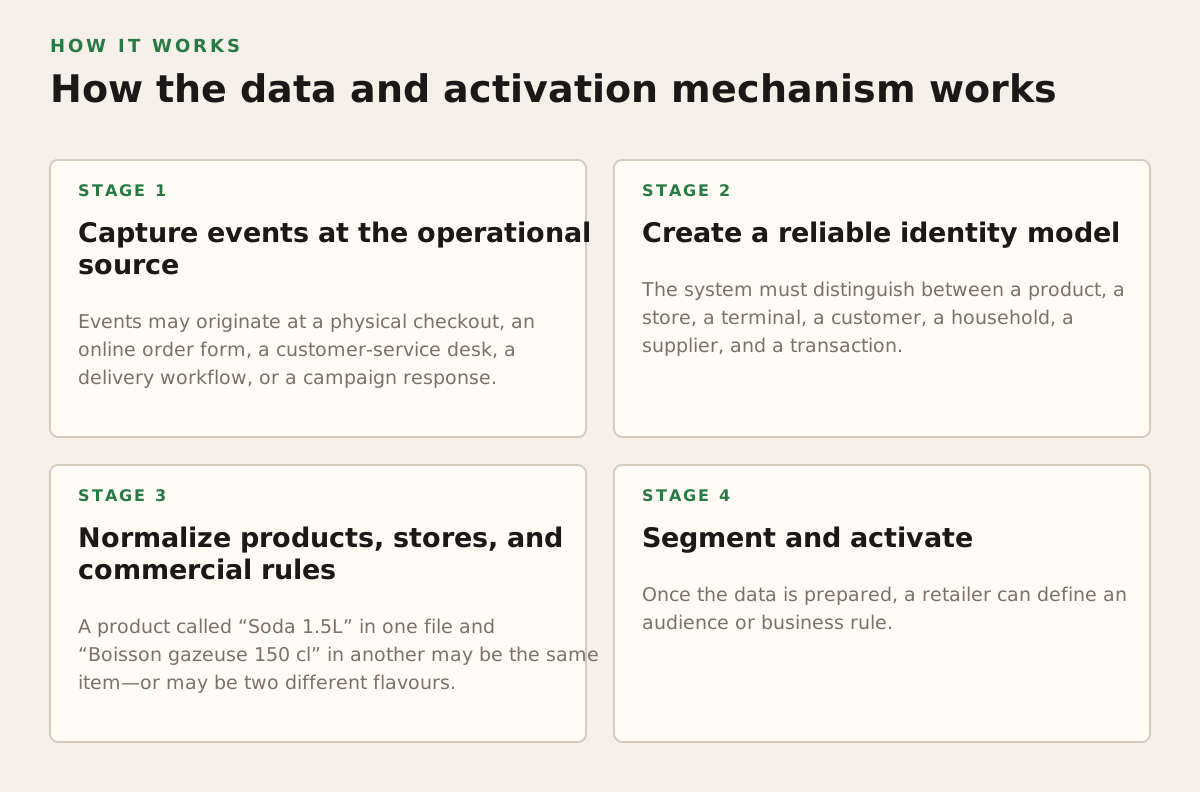
A retail technology programme normally moves through a chain: capture, clean, model, decide, activate, and measure. The chain is only as strong as its weakest handoff. A campaign that is well targeted but supplied with stale stock data can frustrate customers. A loyalty reward with duplicated customer identities can overpay rewards. A supplier report based on inconsistent product codes can create a commercial dispute.
1. Capture events at the operational source
Events may originate at a physical checkout, an online order form, a customer-service desk, a delivery workflow, or a campaign response. At minimum, the event should identify what happened, when it happened, where it happened, and which products or services were involved.
For a shop, that means preserving the transaction lines rather than keeping only the total receipt value. A receipt of 85 Tunisian dinars does not reveal whether the customer bought detergent, bread, or a high-margin accessory. The product lines, quantities, discounts, and return status are what make later analysis possible.
2. Create a reliable identity model
The system must distinguish between a product, a store, a terminal, a customer, a household, a supplier, and a transaction. It should also handle uncertainty. A walk-in customer who declines identification is not the same as a known customer with missing data, and neither should be silently converted into a guessed profile.
Identity resolution needs an explicit confidence rule. For example, an email address may be a strong matching key in one business, while a phone number shared by family members may not identify one individual. A retailer should document what happens when two records appear similar:
- merge automatically only when the matching key and policy justify it;
- send ambiguous cases to a review queue;
- retain a trace of the old identifiers and merge decision;
- avoid using guessed identity for sensitive or high-value rewards;
- allow a customer record to be corrected without rewriting the original transaction.
3. Normalize products, stores, and commercial rules
A product called “Soda 1.5L” in one file and “Boisson gazeuse 150 cl” in another may be the same item—or may be two different flavours. Product codes, pack sizes, brands, units, categories, tax attributes, and active dates need controlled ownership. A branch must also have a stable code, because “Centre-ville,” “Downtown,” and “Store 01” can otherwise become three locations in a report.
The same discipline applies to promotions. An offer needs a start date, end date, participating locations, eligible products, customer eligibility, funding party, discount calculation, and settlement method. Promotion rules must be machine-readable wherever possible. A cashier’s verbal interpretation is not a dependable integration interface.
4. Segment and activate
Once the data is prepared, a retailer can define an audience or business rule. “Customers who bought category X” is still incomplete. A usable segment may specify a purchase window, minimum value, store, exclusion list, communication permission, and frequency limit.
Activation can take several forms:
- a coupon or loyalty reward at checkout;
- a message through a permitted customer channel;
- a product recommendation in a digital catalogue;
- a sponsored placement funded by a supplier;
- a task for a sales representative or store manager;
- a stock or pricing decision based on observed demand.
Every activation should return a status. Did the coupon issue? Was it redeemed? Did the product remain available? Was the customer contacted once or several times? Did the sale occur in the intended location? Without those feedback events, the platform cannot distinguish a successful campaign from a failed delivery.
5. Measure with reconciliation, not just a dashboard
The final report should reconcile with the operational system. If the platform reports 500 promoted units while the point of sale and inventory ledger show 470, someone must explain the gap. Possible causes include delayed imports, returns, cancelled tickets, pack-size conversion, duplicate events, or different date cutoffs.
Retail media adds another layer. A retailer selling sponsored placement must separate exposure, engagement, and transaction outcomes. An impression is not a click; a click is not a purchase; and a purchase after exposure is not automatically incremental. The report should show definitions, time windows, exclusions, and known data gaps so that a supplier can challenge or reproduce the calculation.
When a retailer uses external advertising platforms, the integration should be governed rather than improvised. Google’s official Merchant Center documentation, for example, describes the product data and account requirements used to make products eligible for Google surfaces: Google Merchant Center product data guidance. The operational lesson is broader than Google: product feeds require consistent attributes, update schedules, ownership, and error handling.
Where an Aristid-style retail platform can break
Most failures are not caused by the absence of a clever algorithm. They occur at boundaries: between branches, between product files, between consent and activation, or between a promotional promise and the stock actually available. A retailer should examine these failure modes before signing a project plan.
Inconsistent product and price data
A product can have different prices by branch, pack, customer category, or promotion period. If the engagement layer receives only a product name and a nominal price, it may display an offer that the till cannot honour. The remedy is to transmit the commercial conditions and validity dates, not just a marketing description.
Illustrative example: a distributor imports “coffee 250g” as one item, while the warehouse uses separate codes for ground, beans, and decaffeinated products. A campaign built on the broad description may target buyers of the wrong product and distort replenishment. The starting policy should be a product master owner, a change log, and an exception report for unmapped codes.
Missing or weak customer consent
Personalization and marketing are not the same as simply storing a transaction. A retailer should know what permission was requested, for which channel, when it was granted, and how withdrawal is processed. The European Commission explains the core principles and rights under EU data protection rules in its official overview: Data protection in the EU. Tunisian businesses must also consider applicable local obligations and obtain professional legal advice for their specific processing activities.
Cookies and online identifiers create additional questions. The French data-protection authority CNIL discusses cookies and other trackers, including consent expectations, here: CNIL guidance on cookies and trackers. This is not a substitute for Tunisian legal advice, but it demonstrates the type of control a retailer should expect to document: purpose, collection, retention, access, withdrawal, and vendor responsibility.
- Do not treat a phone number collected for delivery as automatic permission for promotional messages.
- Do not make a loyalty benefit depend on unnecessary personal information unless the business has a defensible reason.
- Do not upload an old spreadsheet of contacts to an activation channel without checking its origin and permissions.
- Do not keep former employees’ or customers’ access active after their business relationship ends.
- Do record suppression requests and propagate them to every downstream campaign list.
Unavailable stock and operational disappointment
A retailer can target a customer perfectly and still lose trust if the promoted item is absent. This is particularly serious for grocery, pharmacy-adjacent retail, fast food, and branches with uneven replenishment. A campaign rule should check stock freshness, safety stock, store eligibility, and substitution policy before activation.
An illustrative starting rule might suppress a store-level promotion when the latest confirmed available quantity is zero, and route exceptions to a manager. That is a policy example, not a universal threshold. The correct rule depends on lead time, supplier reliability, shelf life, and whether the offer can be fulfilled from another location.
Over-attribution and margin blindness
If a customer received an offer and later purchased, it is tempting to credit the whole sale to the campaign. That can overstate performance, especially for products customers buy routinely. A better design separates baseline sales, offer redemption, gross margin, returns, and incremental evidence.
For a café, for example, a “buy two sandwiches” offer may increase units while reducing average contribution per order. The report should include food cost, discount, packaging, payment fees, and any delivery commission relevant to the channel. The right decision may be to keep the offer for quiet hours, not to run it throughout the day.
Integration cost disguised as a feature list
Ask not only whether a platform “integrates with POS.” Ask how. Important questions include:
- Is data exchanged by API, scheduled file, database connector, or manual upload?
- Which application owns corrections and deletions?
- How are duplicate events detected?
- What happens when an import fails halfway through?
- Can the business replay a failed day without duplicating sales?
- How are Arabic, French, and English names represented?
- What is the process for changing a product code or branch code?
- Who monitors the interface, and what does an error look like to that person?
An integration without ownership is a recurring manual task. A small retailer should calculate the people and time required to maintain the data flow, not just the software licence or project fee. If the business cannot appoint an owner for product data, customer permissions, and reconciliation, a narrower operational system may produce more value.
How practitioners should evaluate the fit
Evaluation should begin with a written decision, not a demonstration. A vendor demo can show a polished audience, campaign, or dashboard using clean sample data. The retailer needs to know whether the platform can survive its own messy catalogue, cash corrections, branch transfers, intermittent connectivity, and multilingual workflows.
Start with one measurable use case
Choose a use case with a clear owner and an observable result. Examples include reducing unredeemed loyalty rewards, improving a supplier promotion report, or increasing repeat visits for a defined service. Avoid starting with “we want artificial intelligence” or “we need a 360-degree customer view.” Those descriptions do not specify a decision.
A useful one-page brief contains:
- the business problem and responsible manager;
- the customer or product population involved;
- the source fields required;
- the action the platform should trigger;
- the financial or operational measure;
- the exclusions, consent rules, and stock conditions;
- the date by which the business will review the result.
Illustrative example: a six-branch retailer may define a campaign for customers who bought a particular category at least twice during a stated period, exclude recent purchasers, require permission for the chosen channel, and measure redeemed offers, margin, and repeat purchase. The retailer should set its own dates and thresholds from its sales pattern; these conditions are a design example, not a benchmark.
Test the ugly records
During evaluation, provide representative exceptions—subject to proper confidentiality controls—instead of only perfect records. Include returned items, cancelled receipts, anonymous sales, duplicate customer entries, products sold by weight, Arabic and French descriptions, branch-specific prices, and an item that has been discontinued.
Ask the provider to show the result of each exception. A serious evaluation should reveal whether the system rejects, quarantines, merges, ignores, or silently changes the record. Silent transformation is the most dangerous outcome because staff may trust a result they cannot audit.
Separate operational priorities from advanced activation
Use this order when the business is still building its foundation:
- stabilize product, supplier, customer, and branch master data;
- make checkout, stock movements, purchasing, and cash closing reliable;
- produce consistent sales and margin reports;
- document consent and customer-service procedures;
- then assess loyalty, personalization, supplier-funded promotion, or retail media.
A grocery store with frequent stock discrepancies should not make customer segmentation its first software project. A wholesaler with accurate warehouse records but no repeat-order visibility may reasonably prioritize customer analysis. A repair business may need appointment, technician, parts, and service-history workflows before it needs a retail-media capability at all.
Questions for a provider or implementation partner
- Which capabilities are native, and which depend on another system?
- What data must be available before a use case works?
- Can the retailer export its records in a usable format if the relationship ends?
- How are permissions, suppression lists, and deletion requests handled?
- What is the expected role of the POS, inventory, accounting, and invoicing applications?
- How are offline sales, late files, refunds, and corrections reconciled?
- Can branch managers see only the locations they are authorized to manage?
- What training is required for cashiers, marketers, accountants, and administrators?
For accountants and consultants advising Tunisian SMEs, the key recommendation is to document the architecture in plain language. State which system creates the invoice, which system controls stock, which system records cash, which system owns the customer permission, and which system merely consumes analytical data. This makes future audits, staff changes, and vendor negotiations far less painful.
A practical architecture for a Tunisian SME
Many Tunisian businesses do not need to replicate the architecture of a multinational chain. They need a dependable local operating core and a controlled path to more advanced analysis. The operating core should cover the daily jobs that cannot be postponed: product and supplier records, purchasing, stock by location, point of sale, cash management, customer and supplier balances, reporting, and electronic invoicing where required by the business process.
Above that core, a retailer can add a customer-engagement or retail-data component when the use case justifies it. The connection should transfer only the fields needed for the agreed purpose, on a schedule the business can monitor. A café may need daily product and sales summaries. A multi-warehouse distributor may need more frequent availability updates. A small service company may have no reason to build a retail-media workflow.
| Business profile | First priority | Possible later extension |
|---|---|---|
| Independent grocery store | Barcode sales, replenishment, expiry and stock control, cash closing | Simple customer offers based on permissioned purchase history |
| Multi-branch retailer | Shared item master, branch transfers, price governance, consolidated reporting | Loyalty segmentation and supplier campaign measurement |
| Wholesaler or distributor | Warehouse availability, customer pricing, order and delivery accuracy | Account-based promotions and repeat-order analysis |
| Café or fast-food group | Recipe or item control, modifiers, service channel and cash reconciliation | Time-of-day offers and menu-performance analysis |
| Repair or installation business | Customer history, appointments, parts, quotations, invoices, and payment follow-up | Permissioned service reminders and targeted renewals |
For a small business, a good architecture is not the one with the most layers. It is the one in which every important number has an owner and every interface has an exception process. If the owner cannot answer why stock differs from the campaign feed, why a customer received a message, or why a promotion’s sales do not match the till, the architecture is not yet controlled.
Inventisia is designed as an all-in-one desktop business-management application for Tunisian SMEs, covering inventory, electronic invoicing, point of sale, cash management, customers, suppliers, and reporting on Windows and macOS, with French, Arabic, and English support and lifetime access for a one-time payment. For a retailer that first needs a dependable operational core before adding advanced customer-data activation, explore Inventisia to see how Inventisia can support those day-to-day workflows.
Authored with NotFair SEO
Download Inventisia Now
600 DT · Lifetime access · 3-day free trial · WhatsApp support
Download the app